
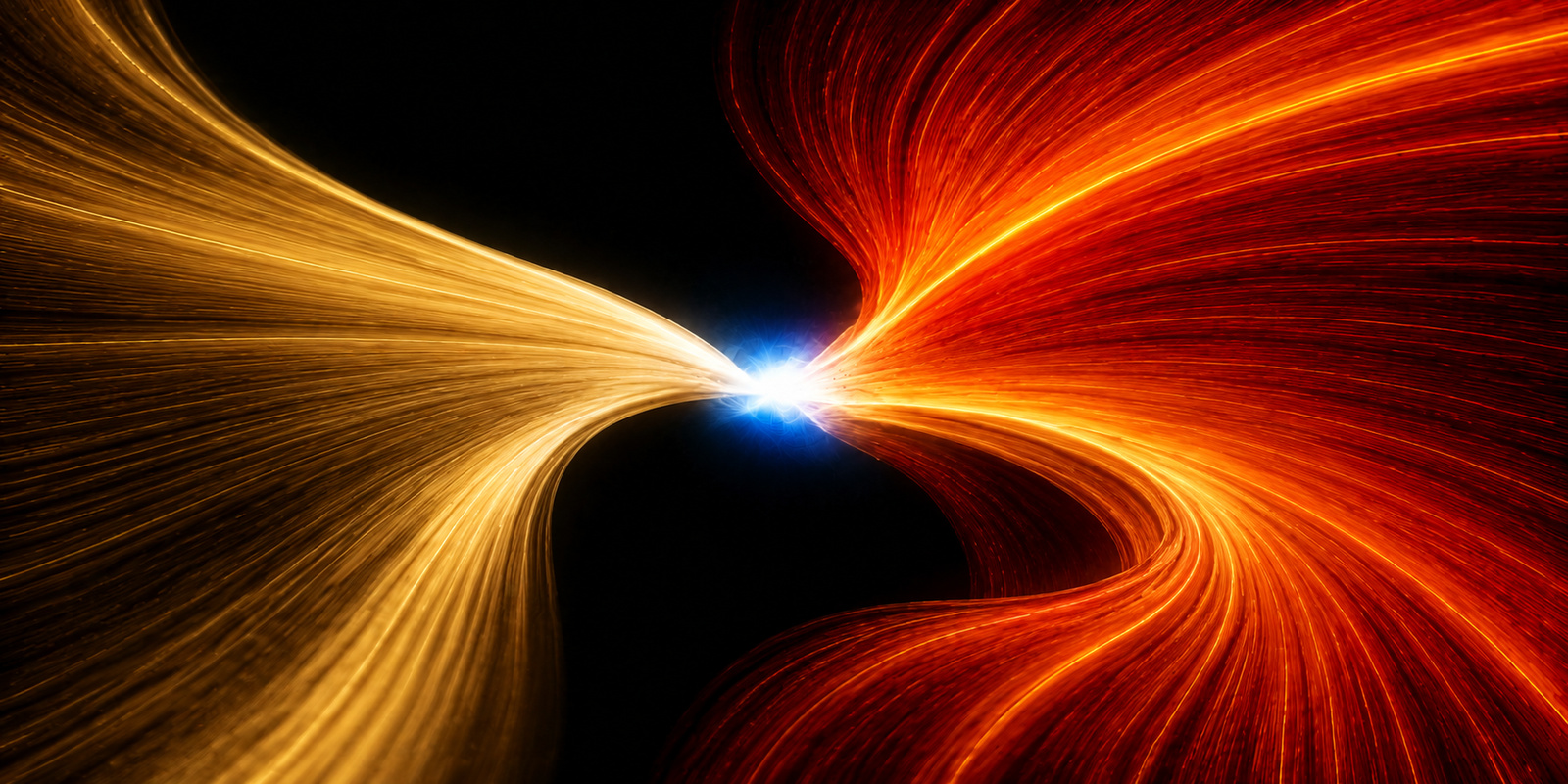
Kinetic radiators for high-power spacecraft.
Every thought leaves as light.
We’re developing Longwave, a kinetic radiator concept that uses moving material to carry heat and release it to space.
Greg Berberian · Founder

More power
means more heat.
Higher-power spacecraft need to move and reject more waste heat. In space, that heat leaves as infrared light.
The hardware that carries and radiates it shapes spacecraft mass, size and capability. Orbital computing makes the stakes vivid, but the opportunity is broader: enabling higher-power missions across space.
Introducing Longwave
Move the surface.
Carry the heat.
Radiating material circulates through a heat-pickup region, carries heat away, and releases it to space.
We’re exploring whether this can reduce the heat-transport hardware distributed across a radiator. The goal is a lighter complete thermal system with a surface that is practical to manufacture and deploy at scale.
Founder / Development
Engineering
the next step.
Greg Berberian · Founder
I’m a mechanical engineer with experience building deployable surfaces for space.
Longwave is at the design and analysis stage with an early mechanical prototype. Next comes instrumented testing of heat transfer, motion, losses and durability.

Continue the
conversation.
Reach out to discuss the technology, business, or what you're building.
Email Greggreg@taldr.comA few questions.
What is Longwave?
Longwave is our kinetic radiator concept for high-power spacecraft.
Design-intent targets · not measured performance
- ≈100 kWmodule class
- 1 MW+modular system scale
- <3 kg/kWcomplete-system target
Kilowatts refer to rejected heat. These are development goals, not a validated design or a measured system result.
Why kinetic rather than conventional radiators?
Conventional panels are the benchmark. Kinetic radiators change how heat reaches the emitting surface, not the rules of radiation. Moving material could reduce distributed heat-transport hardware. Our goal is to let spacecraft reject more heat without a proportional increase in thermal-system mass and complexity.
Who could use it?
Spacecraft builders and integrators whose high-power missions are constrained by heat rejection. Potential applications include orbital computing, nuclear power systems, space-based solar power and directed energy.
What about moving parts?
Tracking, wear, vibration and safe response to a fault are core engineering requirements. We’re developing Longwave around those requirements and building toward instrumented testing.
What is the next step?
Define a useful operating envelope, advance the design and analysis, then test heat transfer, motion, losses and durability together. Representative environmental and lifetime testing would follow successful earlier results.
Why taldr.com?
Taldr began as a software project. The work shifted toward spacecraft hardware; Orbital Surface Foundry is the focus today. The domain and email stayed, for now.